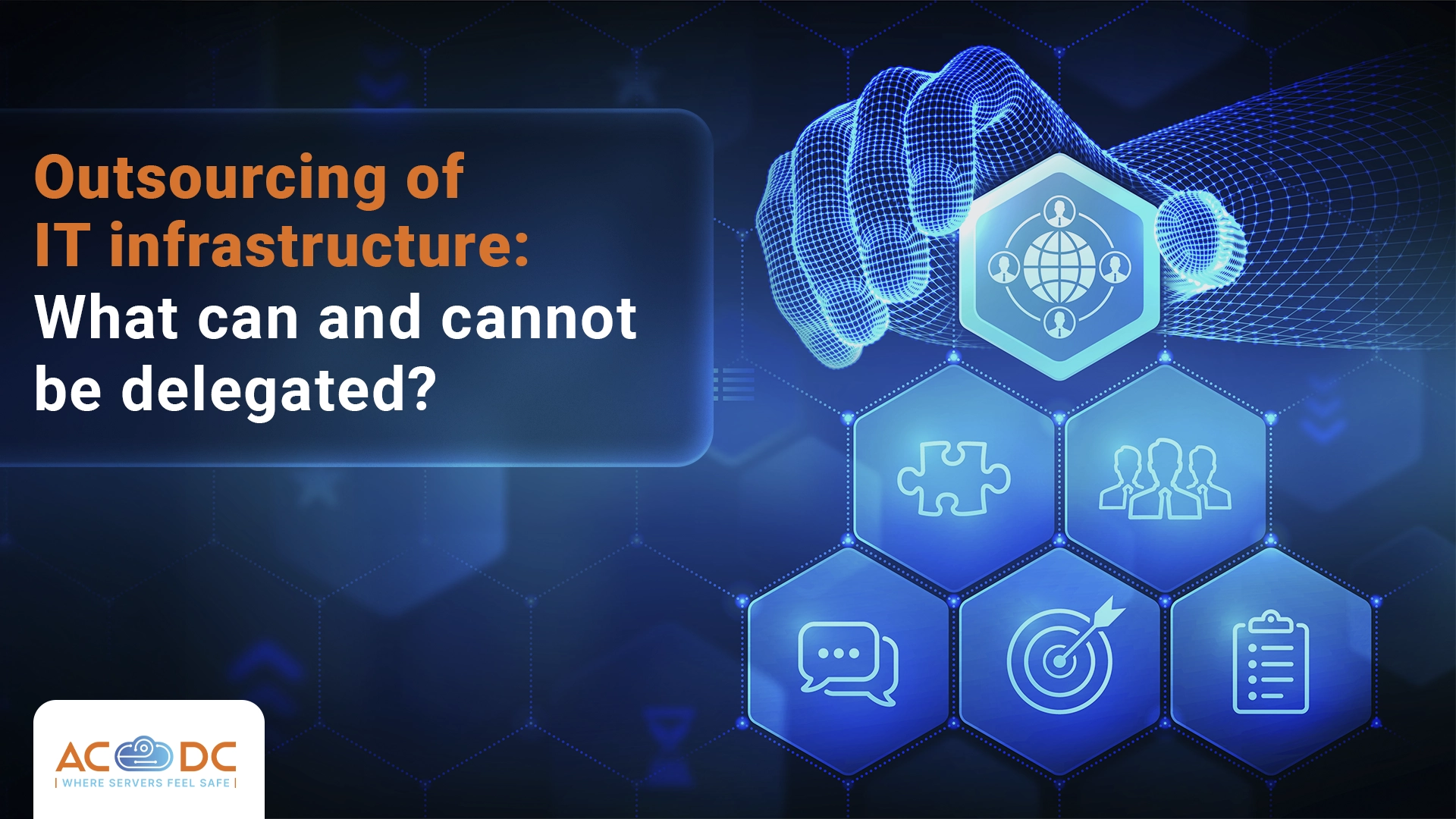





When a business starts talking about data center colocation, some of the most common questions tend to be related to price, technical specifications, and most importantly - the control over their own infrastructure.
And for good reason. IT infrastructure is the backbone of any business - the data, systems, and everything on which daily operations depend. The idea of handing its management over to a third party understandably causes caution.
Uncertainty is often due to a misconception about what colocation actually involves. Recognizing the difference between what the data center manages and what remains entirely your responsibility can significantly change your perception of this type of service.
What is server colocation?
Colocation means renting physical space and infrastructure, but not the management of your systems.
The equipment and operating systems are yours. Applications, configurations, users, data, passwords - all remain entirely under your control. The data center provides the environment where the equipment operates: physical space, power supply, cooling, connectivity, physical security, and monitoring.
You can compare it to renting office space. The landlord provides the building, elevators, air conditioning, and security at the entrance. You decide how to arrange the desks, whom to hire, what processes to implement, and how to manage your business. In such a standard situation, no one would say that renting an office means losing control of the company, right?
What does the data center manage?
The data center manages the part that is usually the most difficult and expensive to maintain independently. If you work with a high-end data center such as AC☁DC, their team will handle:
- The physical environment: Appropriate temperature, humidity, and airflow for server equipment. Built, maintained, and monitored 24/7 - something that a typical office server room can rarely achieve even close to this level.
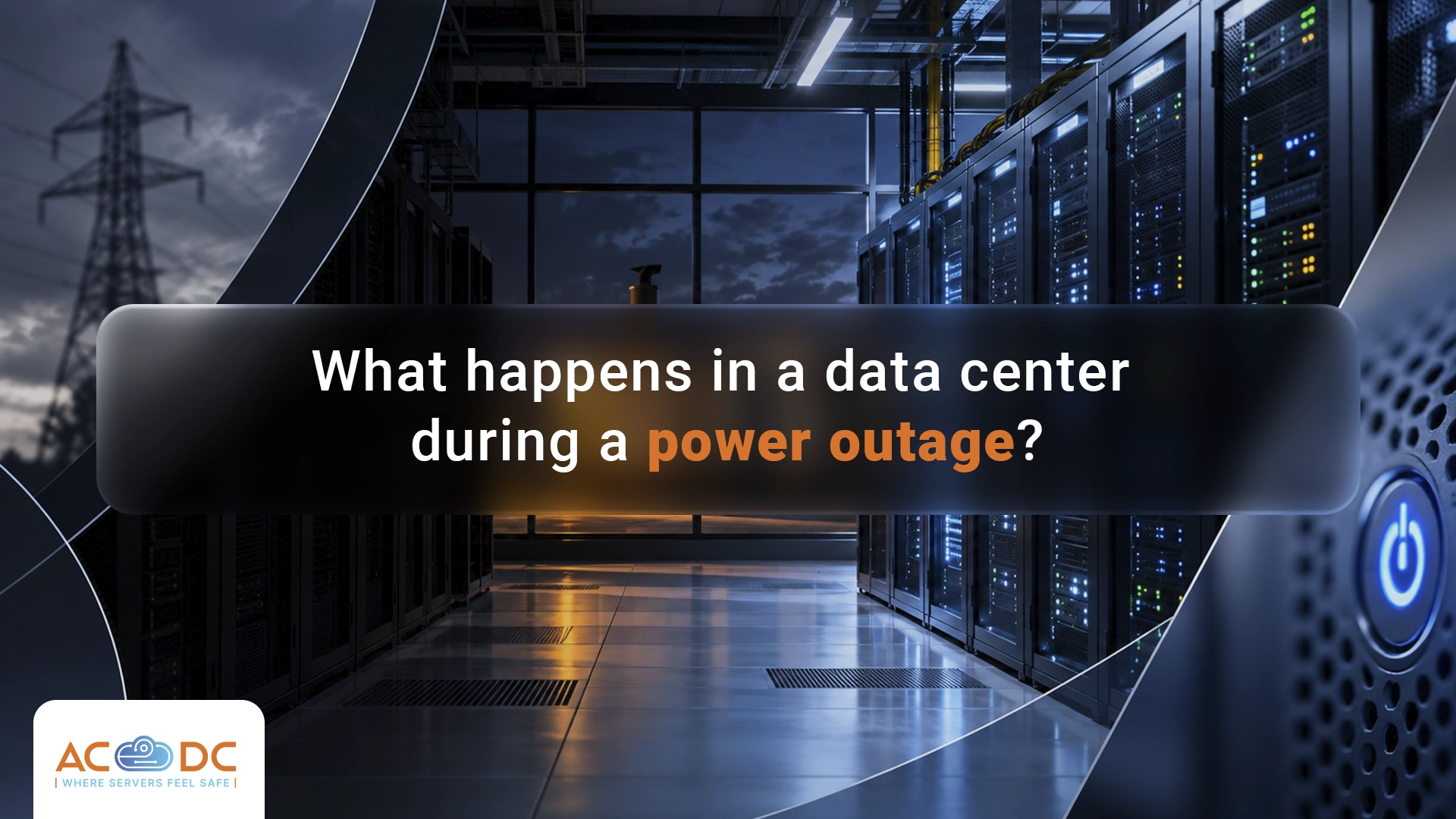
- Power supply and backup: Two independent power feeds, UPS systems, diesel generators. In case of a power outage, your equipment continues to operate without your intervention.
- Physical security: Access control, video surveillance, on-duty staff. Every access to the equipment is tracked and audited. Unauthorized access to the server room is not possible.
- Connectivity: Multiple independent internet providers, connections to internet exchange points, and backup routes. The data center maintains the physical network infrastructure (cabling, switches, etc.).
- Environmental monitoring: Temperature, humidity, power supply, and access are monitored in real time. In case of irregularities, the data center team reacts without requiring any action from you.
- Remote Hands & Eyes: If you need physical intervention (restarting equipment, changing a cable, checking indicators, installing new hardware), the data center team can perform specific tasks per your instructions, so your IT specialist doesn’t need to travel to the site.
What remains entirely under your control?
It’s important to understand that your business retains full control and ownership over critical data and processes even when your server equipment is located in a data center. Your responsibilities include:
- Operating systems and software: Installation, configuration, updates, and everything that happens at the operating system level. The data center team doesn’t know which applications are running on your servers and doesn’t manage their access.
- Network configuration: The data center provides physical connectivity. You configure routers, firewalls, VPNs, VLANs, and everything else according to your needs.
- Data backup: The data center doesn’t automatically back up your data. It ensures a reliable operational environment, but backup maintenance is your responsibility, unless you have specifically requested such a service.
- System access management: Who has access and to which systems, with what rights, and under what conditions, is entirely governed by your policies. The data center handles physical access to hardware, but not to your applications and data.
- Application maintenance: Updating software, firewall configuration, vulnerability management, and incident response at software level remain an internal responsibility or can be further outsourced to a specialized provider.
- Business processes: The data center doesn’t manage how you use technology, only the environment in which it operates.
Colocation improves control over IT and business processes
Many businesses are realizing that server colocation actually gives them more control, not less.
When the server is in the office, you depend on a single person or small team holding all the infrastructure knowledge. If they get sick, leave, or are unreachable in a critical moment, you lose all control.
When your servers are in a data center with documented processes, ISO certifications, and 24/7 monitoring, your infrastructure runs by standards independently of specific personnel. Every access is logged. Every intervention is documented. You have visibility, accountability, and predictability - advantages that keeping a server in an office environment cannot secure for you.
In addition, a neutral data center doesn’t tie you to a specific internet provider or cloud operator. You can freely choose among available providers, switch or combine them without physically moving your equipment, thus having more options.
What and to whom can you choose to additionally delegate?
Colocating server equipment is only part of IT infrastructure outsourcing for a company. Other options exist, forming part of comprehensive solutions in this area:
- IT support or Managed Services cover monitoring and maintenance of operating systems, applications, and network configuration. Providers of these services work with your equipment in the data center or in another environment.
- Cloud services, where you rent computing power rather than physical equipment. This provides maximum flexibility, but also creates dependency on the provider.
- Hybrid model: Own or leased equipment in colocation combined with cloud services for specific needs. This is the most common model for small and medium businesses who have found their balance between control, costs, and flexibility. Read more on how to choose between colocation and cloud depending on your business needs.
If you are planning your IT infrastructure or looking for opportunities to optimize costs, improve cybersecurity or the efficiency of your processes, contact the IT experts at AbsCloud. We will guide you to solutions tailored to your exact business needs.
Свържете се с нас
Интересувате се от колокация на сървъри или други услуги? Свържете се с екипа ни още сега.

 23 September, 2026
 16 September, 2026
 9 September, 2026
 27 August, 2026
 18 August, 2026
 11 August, 2026
 4 August, 2026
 28 July, 2026
 21 July, 2026
 15 July, 2026
 7 July, 2026
 30 June, 2026
 21 June, 2026
 16 June, 2026
 9 June, 2026
 2 June, 2026
 27 May, 2026
 19 May, 2026
 6 May, 2026
 21 April, 2026
 15 April, 2026
 8 April, 2026
 1 April, 2026
 24 March, 2026
 18 March, 2026
 11 March, 2026
 4 March, 2026
 26 February, 2026
 19 February, 2026
 5 February, 2026
 3 February, 2026
 27 January, 2026
 20 January, 2026
 13 January, 2026
 8 January, 2026
 4 January, 2026
 22 December, 2025
 17 December, 2025
 10 December, 2025
 4 December, 2025
 26 November, 2025
 17 November, 2025
 11 November, 2025
 4 November, 2025
 27 October, 2025
 20 October, 2025
 8 October, 2025
 5 October, 2025
 30 September, 2025
 19 September, 2025
 15 September, 2025
 4 September, 2025
 29 August, 2025
 23 August, 2025
 16 August, 2025
 12 August, 2025
 6 August, 2025
 28 July, 2025
 22 July, 2025
 15 July, 2025
 11 July, 2025
 3 July, 2025
 19 June, 2025
 3 June, 2025
 27 May, 2025
 21 May, 2025
 14 May, 2025
 7 May, 2025
 29 April, 2025
 23 April, 2025
 14 April, 2025
 8 April, 2025
 27 March, 2025

 0882 355 203