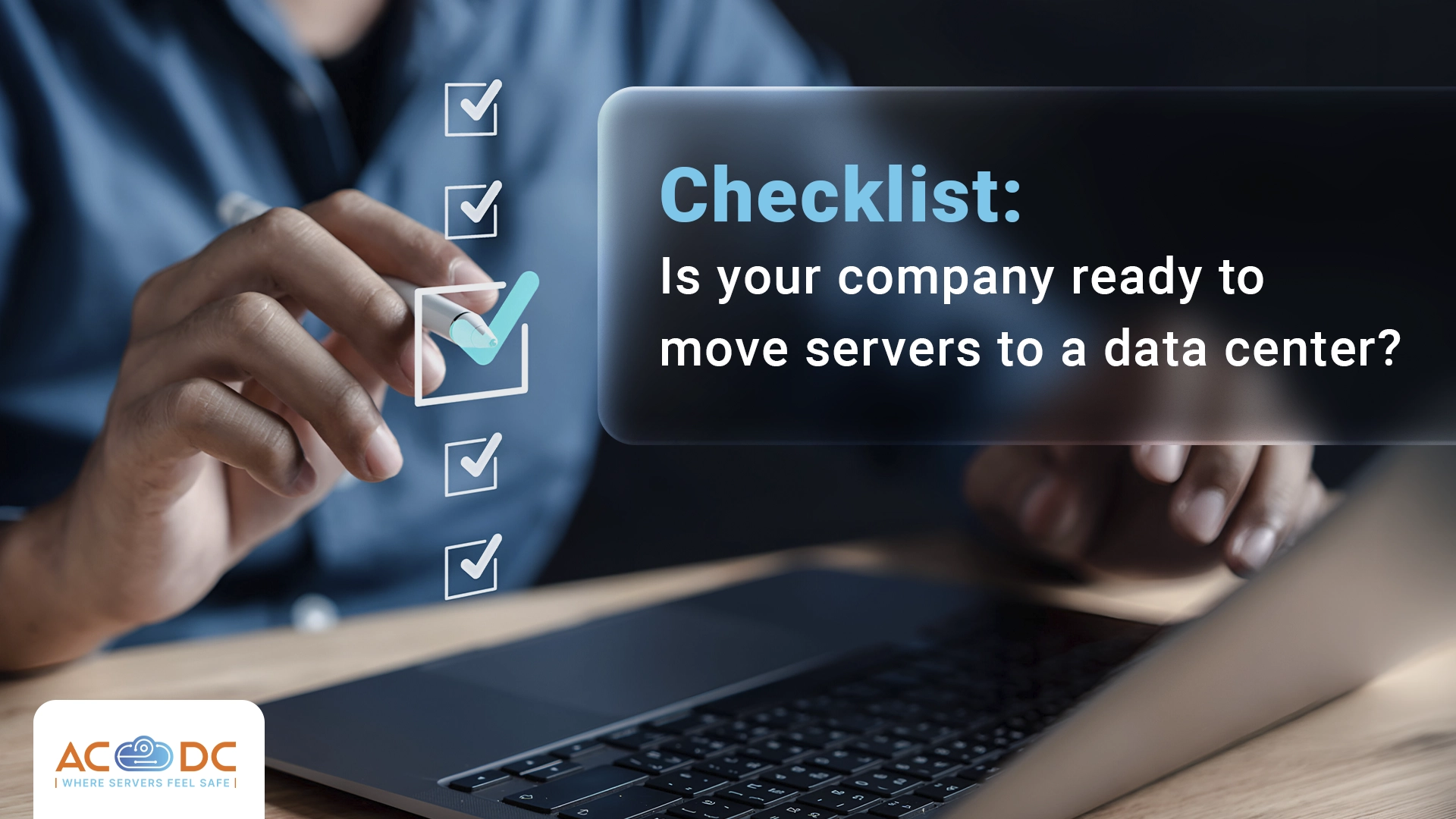






The decision to move server equipment to a data center is rarely made in a single day. Usually, this decision is backed by planning for the next stage of business growth, or in some cases, by an unfortunate experience such as a breakdown, data loss, the departure of a key specialist, or another event that makes it clear to the company that it is no longer able to manage its server equipment independently.
When the time comes, the question is not only “Which data center should we choose?” but also “Are we ready for this relocation?”. The following checklist helps you assess your organization’s readiness (technically, operationally, and organizationally) before taking action.
Technical Readiness
What equipment do you have and what is its condition?
Before planning a relocation, you must be aware of the exact specifications of your equipment: what servers, switches, and storage devices you have, their age, their current workloads, and how much physical space they occupy.
Are you aware of your equipment's power consumption?
Data centers charge based on power, in kilowatts (kW). If you don’t know how many watts each device consumes, you cannot receive an accurate offer. Consumption can be measured with a PDU meter or estimated from equipment specifications. As a guideline, a standard 1U server consumes between 100 and 400W depending on configuration.
Do you have rack-mount or tower servers?
Rack-mount equipment fits directly in a standard rack. Tower servers have a different form factor and require specific tower colocation or adapters for rack installation. It is important to clarify this in advance, as it affects the type of space rented and the installation process. Not every data center can offer you the specialized service of Tower colocation.
Is your network configuration documented?
IP addresses, VLAN configurations, routing, DNS settings, firewall rules... All of this should be documented before relocation. An undocumented network is the most common source of migration problems. If only one specialist is familiar with the configuration, this is a risk that needs to be addressed regardless of the move.
Do you have a connectivity plan for the data center?
Which internet providers will you use? Will you transfer your current provider, or choose a new one? Do you need a backup link with a second provider? A neutral data center gives you the freedom to choose and combine providers, but it’s good to have a clear idea of your needs in advance.
Do you have specific requirements for the physical environment?
Some types of equipment or business activities have special requirements—a non-standard rack depth, need for direct water cooling, special cabling or power supply with a voltage other than the standard, or additional security measures such as a personal key, separating equipment in a private cage, and more. If you have such requirements, clarify them with the data center before signing a service contract.
Operational Readiness
Do you have up-to-date backups of all systems?
Relocation is a point of increased risk for data, even with maximum precision. Before physically transporting equipment, you must have a complete and tested backup of all critical data and systems.
Do you have a plan for downtime during the move?
Moving physical equipment may mean downtime for a certain period. The question is when is the best moment (weekend, at night, at month’s end), how long is downtime tolerable, and how to inform affected users or clients. Planning the downtime window is an operational decision and should be tailored for each business individually.
Do you have a rollback plan in case of issues?
What happens if something doesn't work after the move? Do you have the option to roll back to the previous configuration if migration doesn't go as planned? Even if unlikely, the rollback plan is a mandatory safety measure.
Do you know who will carry out the physical relocation?
Transporting and installing server equipment requires care and experience. You need to know in advance whether installation will be done by your specialist, the data center team, or a third party. AC☁DC has a loading ramp, freight elevator, and setup room where the equipment can be transported and prepared before installation.
Have you planned testing after the move?
A successful physical move is not the end of the process. After installation, system testing is needed: do all services work, are the systems accessible from all locations, are backups functioning, are the connectivity SLA parameters met. The testing plan should be ready in advance, not improvised on the spot.
Organizational Readiness
Are all affected parties informed about the move?
The IT team, management, key system users, clients, or partners relying on your infrastructure—all must be informed of the planned move, expected downtime, and the communication procedure in case of issues. Surprises in this process can be unpleasant and lead to serious financial and reputational consequences, especially when third-party business processes are affected.
Are contractual relationships with the current provider clear?
If you are currently using managed hosting, VPS, or cloud service, before relocating be sure to check the contract termination conditions: minimum notice period, penalties, data migration procedure. If you operate your own server in a rented location, check the access and equipment removal conditions.
Are responsibilities distributed after the move?
Colocation separates responsibilities: the data center is responsible for the physical environment and connectivity, while you are responsible for everything else, unless you arrange for additional services from the provider. It is important to clarify internally who is responsible for system monitoring, who reacts in case of incidents, and who is the contact person for the data center. Uncertainty on these points is more risky than any technical problem.
Do you have enough information to choose a data center?
Before signing a contract, you should have answered the basic questions: What is the TIER classification, what SLA guarantees exist, what ISO certificates does the provider hold, how is the power supply reserved, which providers are available, and under what conditions can the contract be terminated. If you are still gathering this information for your business, see the questions that will help you choose a data center in Bulgaria.
Financial Readiness
Have you done a full cost calculation?
Colocation has a predictable and transparent cost model, unlike managing your own infrastructure, where expenses are spread out and hard to track. Before comparing offers, calculate the real cost: electricity, cooling, physical security, equipment maintenance, and the IT specialist’s time spent on infrastructure-related tasks.
Have you planned for one-time relocation expenses?
Transport, cabling, additional switches and components, 3D accessories, etc. may be part of the additional one-time costs during relocation. The good news is that these are usually predictable, and the data center can help you calculate or optimize them.
Are you ready to move your servers to a data center?
If you have answered most of the questions above, your business is likely highly prepared for relocating servers to a data center. Consult the IT experts at AC☁DC to learn what the entire relocation process includes, where your responsibilities lie, and which steps the data center team can handle for you.
Свържете се с нас
Интересувате се от колокация на сървъри или други услуги? Свържете се с екипа ни още сега.

 7 October, 2026
 30 September, 2026
 23 September, 2026
 16 September, 2026
 9 September, 2026
 27 August, 2026
 18 August, 2026
 11 August, 2026
 4 August, 2026
 28 July, 2026
 21 July, 2026
 15 July, 2026
 7 July, 2026
 30 June, 2026
 21 June, 2026
 16 June, 2026
 9 June, 2026
 2 June, 2026
 19 May, 2026
 12 May, 2026
 6 May, 2026
 21 April, 2026
 15 April, 2026
 8 April, 2026
 1 April, 2026
 24 March, 2026
 18 March, 2026
 11 March, 2026
 4 March, 2026
 26 February, 2026
 19 February, 2026
 5 February, 2026
 3 February, 2026
 27 January, 2026
 20 January, 2026
 13 January, 2026
 8 January, 2026
 4 January, 2026
 22 December, 2025
 17 December, 2025
 10 December, 2025
 4 December, 2025
 26 November, 2025
 17 November, 2025
 11 November, 2025
 4 November, 2025
 27 October, 2025
 20 October, 2025
 8 October, 2025
 5 October, 2025
 30 September, 2025
 19 September, 2025
 15 September, 2025
 4 September, 2025
 29 August, 2025
 23 August, 2025
 16 August, 2025
 12 August, 2025
 6 August, 2025
 28 July, 2025
 22 July, 2025
 15 July, 2025
 11 July, 2025
 3 July, 2025
 19 June, 2025
 3 June, 2025
 27 May, 2025
 21 May, 2025
 14 May, 2025
 7 May, 2025
 29 April, 2025
 23 April, 2025
 14 April, 2025
 8 April, 2025
 27 March, 2025

 0882 355 203