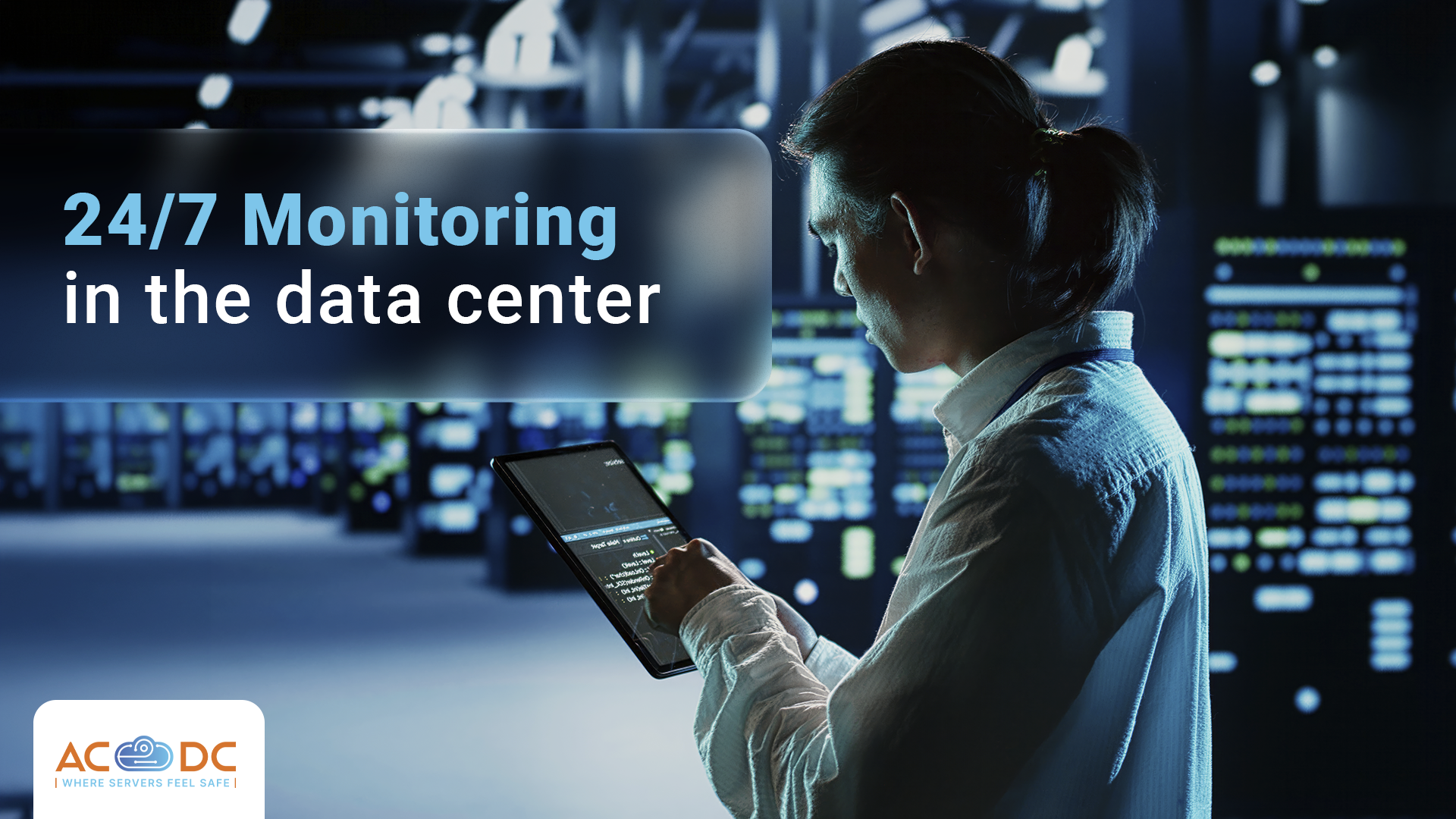






Monitoring is probably the only IT process whose success is measured by its invisibility. When it works properly, it’s not noticed, and nothing unusual happens. Servers run, data is accessible, business continues according to plan. Only when monitoring stops working (or was never present), do the consequences become obvious.
Companies maintaining their own server infrastructure rarely realize the true cost of quality monitoring until they calculate it in detail or suffer an incident that could have been prevented.
What is monitored in the data center
Monitoring in the data center is not a single process. It’s parallel observation of multiple independent systems, each with different parameters, thresholds, and reaction logic:
Power and Electrical Infrastructure:
This is the foundation everything else stands on. Power monitoring tracks in real time:
- Incoming voltage and current: deviations from nominal values precede failures. Voltage outside the permissible range damages equipment even without a complete outage.
- UPS system load: how much of the uninterruptible power capacity is used, the current state of batteries, and how much autonomy time is expected if incoming power fails.
- Diesel generator operation: during planned tests and actual activations (did they start, time to assume load, fuel level).
- PDU (Power Distribution Unit) at rack level: real-time consumption on individual circuits. Data is useful not only for responding to problems but also for capacity planning and TCO calculations for clients.
When deviations from the norm occur (a slight voltage fluctuation, increasing UPS load), the system registers the event. At certain thresholds, it sends an alarm; the engineer sees the problem before it turns into an incident.
Temperature and Cooling
Heat is the second critical factor for normal hardware operation. A modern server generates a significant amount of heat (a densely configured rack can produce 5-15 kW, and a GPU cluster for AI workloads even more). Cooling must continuously remove this heat.
Temperature monitoring tracks:
- Incoming and outgoing air temperature at each rack. The difference between the two shows cooling efficiency for that specific zone.
- Operation of climate units (CRAC/CRAH): temperature, humidity, fan speed, cooling capacity. If one unit fails, the others assume the load, but monitoring determines if they are sufficient.
- Hotspot sensors: local areas with increased temperature due to poor airflow management, blocked panels, or unexpected load increases.
- Humidity: too low and it risks static electricity, too high and there’s a risk of condensation. Both damage equipment.
Temperature monitoring gives alerts for normal, hazardous, or critical operating temperatures; the last level requires an immediate response, any time of day or night.
Physical Security and Video Surveillance
Physical access to the server room is a major factor and also a risk for information security and physical equipment. Monitoring here includes:
- Access control: every entry and exit is registered with full traceability of who, when, and which area was accessed.
- Video monitoring of data center and server zones. Video footage is stored for a specified period and is available for incident investigation.
- Smoke and fire detectors using various technologies (optical, ionization, aspiration systems for early detection) in zones of varying criticality. Fire systems in data centers are integrated with automatic suppression.
- Water detectors on the floor, under and around cooling equipment. Timely detection of leaks prevents major incidents.
Monitoring as a Process in the Data Center
Monitoring tools vary, but are not particularly effective without the process that connects them to:
- A duty team available 24/7 who can immediately assess a potential risk signaled by an alert.
- Escalation procedures triggered by different identified minimal or critical problems. In all cases, it should be clear who is notified, in what timeframe, and who makes specific decisions. The goal is to minimize improvisation under stress by people lacking full context for the situation.
- Regular reviews and tests of the monitoring system, enhanced with simulations and checks of escalation procedures.
- Storing and using historical data and trends. For example, you might not notice a temperature peak in a particular area, but establish that it’s been systematically rising over the past months and take timely actions.
The Advantage of an Already Built Infrastructure
Companies maintaining their own server infrastructure rarely have an equivalent level of monitoring, as building it is expensive and requires specialized expertise.
With colocation in a data center, however, the client benefits from monitoring infrastructure developed and optimized over years, without financing its development.
The monthly fee for colocation in a high-end data center also covers:
- 24/7 continuous monitoring of power, temperature, cooling, and physical security
- 24/7 on-call technical team
- Incident response within minutes
- Documented procedures and escalation chains
- Historical infrastructure data available as needed
The company pays for infrastructure at a level of capacity and maturity that it could achieve on its own only after years and with an investment unaffordable for most organizations.
Important note: data center monitoring covers the physical infrastructure – power, cooling, and security. Monitoring of the client’s own servers and applications is a separate task, for which the company remains responsible.
Monitoring as a Competitive Advantage
For companies that understand the value of continuous monitoring, it’s not an expense, but an investment in reliability and security. Every hour of downtime has a price—lost transactions, affected clients, reputational damage, internal productivity loss, etc. For most businesses, calculations show that even a single prevented incident can justify the annual cost of quality server monitoring infrastructure.
Of course, monitoring doesn’t prevent all problems, but it provides the reaction time needed before small issues turn into major crises.
See more on the topic:
What happens in the data center during a power outage?
How to calculate losses caused by office server downtime?
If you want to learn more about the monitoring infrastructure at AC☁DC and how it affects the reliability of your systems, contact our team today.
Свържете се с нас
Интересувате се от колокация на сървъри или други услуги? Свържете се с екипа ни още сега.

 10 November, 2026
 3 November, 2026
 28 October, 2026
 21 October, 2026
 13 October, 2026
 7 October, 2026
 30 September, 2026
 23 September, 2026
 16 September, 2026
 9 September, 2026
 27 August, 2026
 18 August, 2026
 11 August, 2026
 4 August, 2026
 28 July, 2026
 21 July, 2026
 15 July, 2026
 7 July, 2026
 30 June, 2026
 21 June, 2026
 16 June, 2026
 9 June, 2026
 2 June, 2026
 27 May, 2026
 19 May, 2026
 12 May, 2026
 6 May, 2026
 21 April, 2026
 15 April, 2026
 8 April, 2026
 1 April, 2026
 24 March, 2026
 18 March, 2026
 11 March, 2026
 4 March, 2026
 26 February, 2026
 19 February, 2026
 5 February, 2026
 3 February, 2026
 27 January, 2026
 20 January, 2026
 13 January, 2026
 8 January, 2026
 4 January, 2026
 22 December, 2025
 17 December, 2025
 10 December, 2025
 4 December, 2025
 26 November, 2025
 17 November, 2025
 11 November, 2025
 4 November, 2025
 27 October, 2025
 20 October, 2025
 8 October, 2025
 5 October, 2025
 30 September, 2025
 19 September, 2025
 15 September, 2025
 4 September, 2025
 29 August, 2025
 23 August, 2025
 16 August, 2025
 12 August, 2025
 6 August, 2025
 28 July, 2025
 22 July, 2025
 15 July, 2025
 11 July, 2025
 3 July, 2025
 19 June, 2025
 3 June, 2025
 27 May, 2025
 21 May, 2025
 14 May, 2025
 7 May, 2025
 29 April, 2025
 23 April, 2025
 14 April, 2025
 8 April, 2025
 27 March, 2025

 0882 355 203