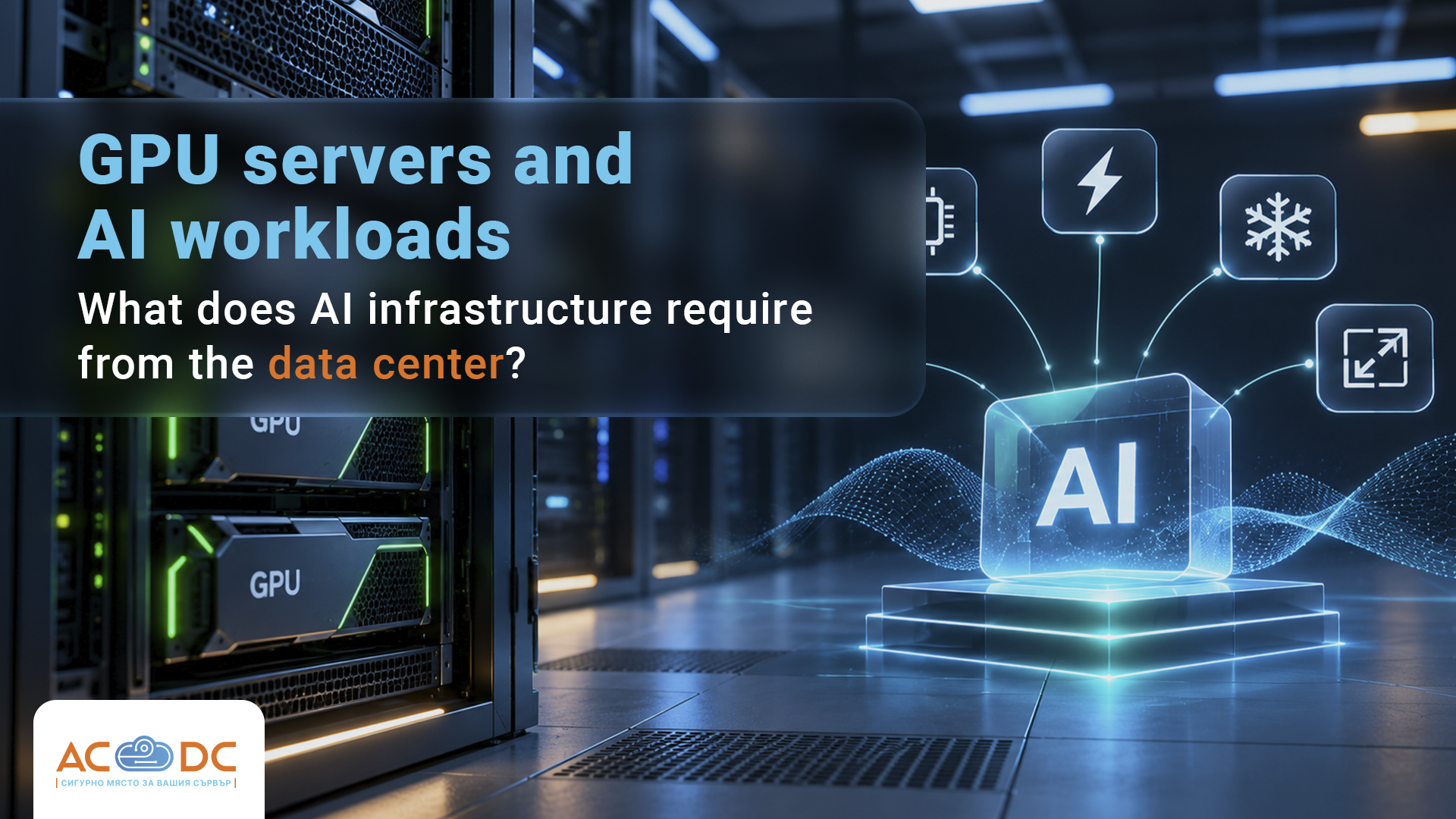






Behind every AI model, generated image, chatbot, and recognition system lies physical hardware—much more demanding than a standard server. Companies building their own AI infrastructure quickly face requirements for which office server rooms or standard hosting services are not designed.
We’re creating this article for companies that are building or planning their own AI infrastructure, models with proprietary data, local processing, or modification of existing models.
Why GPU, not CPU
The computational core of artificial intelligence is the so-called Graphics Processor Units (GPUs)—graphic processors acting as universal computational machines. The difference compared to Central Processing Units (CPUs) is in speed, but also in architecture. CPUs are designed for sequential tasks of high complexity, whereas GPUs process thousands of simple operations simultaneously. Training and executing such networked systems triggers a significant number of processes, run in parallel on a massive scale.
Infrastructure requirements for such machines
A standard 1U server consumes dozens of times less power than a GPU server for AI workloads, and the difference is not only quantitative but also qualitative. Many standard data centers are not designed to deliver the necessary power to a single rack with such machines, even if sufficient total capacity is available. Similar requirements exist for cooling and network connectivity needed by servers handling AI workloads.
AI models are extremely sensitive to latency and network throughput issues. Their training requires continuous reading of huge amounts of data or file systems, while current real-time traffic is being handled—at high speed. Loss of connectivity or deterioration in parameters can directly lead to loss of revenue for the business behind the AI model.
Most common scenarios for businesses
- Adapting an existing model: The company wants to adapt an open-source model to its own data and processes. During the model training period, higher resources may be needed, and after its deployment—maintenance of fewer servers. From an infrastructure perspective, you’ll need a flexible contract with your data center that can be adapted at different stages of the project’s development.
- Development of an in-house model, which the company launches for clients (chatbot, public API, service system, etc.), and which requires high reliability and 24/7 availability. Colocation in a Tier 3 data center is a natural choice for this scenario, as it can guarantee constant availability and reserved power and cooling for the equipment.
- The company operates with sensitive data under regulatory requirements, as is the case for financial institutions, healthcare organizations, and any other company subject to the GDPR regulation, that cannot operate with cloud AI services. Since full control over the data and physical isolation in an auditable environment is required, colocation in a certified data center is the optimal and most cost-effective option for such businesses.
Why a server in the office will not work for AI workloads
Companies trying to build AI infrastructure in their office server rooms almost always face the obvious limitations:
- Power is insufficient: Office electrical installations are designed for lower loads. Adding 10–50 kW of computing equipment requires reconstruction, permits, new circuit boards, and so on.
- Cooling is also insufficient: The office air conditioning is not designed for the heat generated by servers. A 10 kW GPU server generates heat equivalent to a small room with electric radiators running continuously.
- Noise: GPU servers are significantly noisier than standard servers due to the aggressive air cooling needed. Their operation in an office environment is practically impossible if you want to maintain normal working conditions.
- Downtime is expensive: Interruptions in the training process mean lost computational resources and time, as well as the need to restart. With months set aside for training, such incidents can be prohibitively expensive for business.
How to choose a data center for your AI project?
When choosing a data center for AI infrastructure, some of the questions you should ask are:
- What is the maximum rack power the data center can provide?
- Is there specific air or water cooling available?
- What is the maximum power available in the AI zone?
- Does the data center have knowledge and experience working with GPUs?
- What UPS capacity is available for AI workloads?
- What options are offered for high network connectivity requirements?
At AC☁DC, we have Tier 3 infrastructure and work with clients who have high power and resource requirements. If you're planning AI infrastructure and want to discuss specific requirements, contact our team to get a realistic assessment of the requirements and necessary capacity before you order hardware.
See also:
The real infrastructure behind most AI models
How much does server colocation cost and how is the price determined
Свържете се с нас
Интересувате се от колокация на сървъри или други услуги? Свържете се с екипа ни още сега.

 17 November, 2026
 10 November, 2026
 3 November, 2026
 28 October, 2026
 21 October, 2026
 13 October, 2026
 7 October, 2026
 30 September, 2026
 23 September, 2026
 16 September, 2026
 9 September, 2026
 27 August, 2026
 18 August, 2026
 11 August, 2026
 4 August, 2026
 28 July, 2026
 21 July, 2026
 15 July, 2026
 7 July, 2026
 30 June, 2026
 21 June, 2026
 16 June, 2026
 9 June, 2026
 2 June, 2026
 27 May, 2026
 19 May, 2026
 12 May, 2026
 6 May, 2026
 21 April, 2026
 15 April, 2026
 8 April, 2026
 1 April, 2026
 24 March, 2026
 18 March, 2026
 11 March, 2026
 4 March, 2026
 26 February, 2026
 19 February, 2026
 5 February, 2026
 3 February, 2026
 27 January, 2026
 20 January, 2026
 13 January, 2026
 8 January, 2026
 4 January, 2026
 22 December, 2025
 17 December, 2025
 10 December, 2025
 4 December, 2025
 26 November, 2025
 17 November, 2025
 11 November, 2025
 4 November, 2025
 27 October, 2025
 20 October, 2025
 8 October, 2025
 5 October, 2025
 30 September, 2025
 19 September, 2025
 15 September, 2025
 4 September, 2025
 29 August, 2025
 23 August, 2025
 16 August, 2025
 12 August, 2025
 6 August, 2025
 28 July, 2025
 22 July, 2025
 15 July, 2025
 11 July, 2025
 3 July, 2025
 19 June, 2025
 3 June, 2025
 27 May, 2025
 21 May, 2025
 14 May, 2025
 7 May, 2025
 29 April, 2025
 23 April, 2025
 14 April, 2025
 8 April, 2025
 27 March, 2025

 0882 355 203